
One-, two- and three-car garages
Epoxy Garage Floors in Houston, TX
A sealed garage floor that sheds oil, rain and storm mud and stays put under tires that just came off hot pavement.
- Free on-site estimates across the Houston area
- Moisture testing on the slab before any coating goes down
- Written quotes that spell out the prep and every coat
Why Houston Garages Need More Than a Coat of Paint
Epoxy Garage Floors in Houston have a tough job. A garage here is a hot, humid room that also takes in rainwater off the car, mud after storms and tires that have just spent an hour on sun-baked roads. Bare concrete soaks up oil, sheds dust and stains easily. A properly installed epoxy garage floor seals that concrete under a hard, cleanable layer, so spills wipe up and the floor stops dusting. Houston Epoxy Flooring Pros installs garage floor epoxy systems built for those conditions, starting with tests and prep that most cheap jobs skip.
Why garage coatings fail here
When a garage floor coating peels, there are usually three suspects. The first is moisture. Wikipedia describes Houston as sitting on low-permeability clay-silt prairie soils, and wet clay under a slab can push vapor up into the coating. The second is prep. Acid etching or a quick wash leaves a smooth, weak surface that the resin cannot grip. The third is the product. Thin, water-based kits are cheap and easy, but HomeGuide puts the life of a water-based epoxy at 3 to 5 years, compared with 10 to 20 years for a solid epoxy system. We test for the first, grind away the second and do not use the third.
Hot-tire pickup
A tire that has been running on hot pavement softens slightly and grips whatever it parks on. When the car pulls away later, it can tear a poorly bonded coating right off the slab, leaving bare patches in the shape of tire tracks. With Bush Intercontinental at 90F or more on an average of 106.5 days a year, this is a real risk in Houston garages, not a rare one. The fix is not a magic product. It is mechanical bonding from diamond grinding, a coating with enough solids and build to stay hard, and a topcoat that is fully cured before the first car rolls in.
How we build the floor
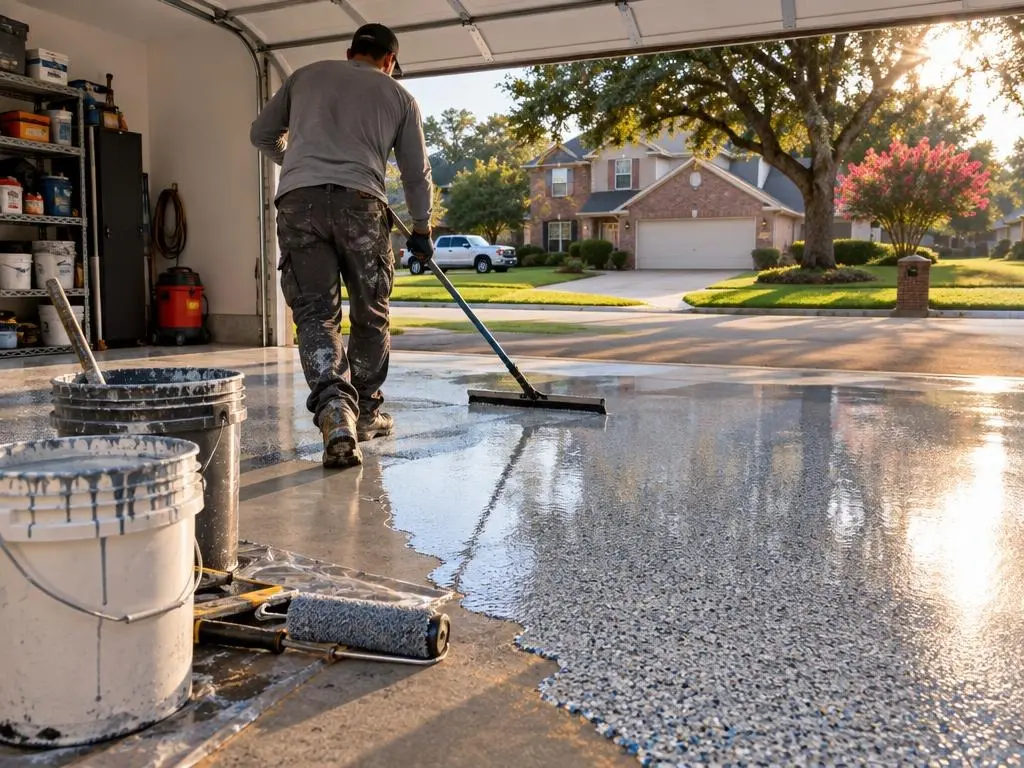
Our standard garage system starts with full diamond grinding of the slab and its edges. Cracks get chased out and filled, and spalled spots and chipped joints are patched so they do not telegraph through. On slabs that test damp, we lay a moisture-mitigating primer. Then comes a pigmented epoxy base coat that builds real thickness, followed by either a solid color finish or a broadcast of decorative flakes. The top layer is a clear coat, usually polyaspartic, because it holds its color where sun reaches the floor and resists the scuffing that comes with daily parking. Every layer is listed in your quote.
When the garage is also a shop or gym
Plenty of Houston garages are also a workshop, a laundry spot, a home gym or a place to store a boat or golf cart. We plan the floor around that. A shop floor where jack stands, welding spatter or dropped tools are common may need a thicker build. A gym area can be finished with less texture under a rubber mat. A boat on a trailer drips water, so we add grip with a broadcast or texture additive. Golf cart batteries and pool chemicals can spill, so a chemical-resistant topcoat is worth asking about. Tell us what happens in the space and we will match the system to it.
DIY kit or professional install?
HomeGuide puts DIY garage floor kits at $200 to $700, and for a lightly used garage that may be enough for a few years. The difference is in the prep and the chemistry. Most kits rely on an acid etch and a thin water-based or low-solids epoxy, while our installs use diamond grinding, a high-build base and a hard topcoat. On a Houston slab with moisture under it and hot tires on top, that difference tends to show up in the second or third summer. If you are weighing the two, we are happy to explain where a kit makes sense and where it does not.
Living with the new floor
HomeGuide's epoxy guide says to keep vehicles off fresh epoxy for 2 to 7 days; for polyaspartic, its figure for heavy vehicle traffic is 24 to 48 hours. Your exact times come from us on the day we finish. After that, care is simple: sweep or blow out grit, which is what scratches a floor over time, and mop with a mild cleaner. Wipe up oil, brake fluid and pool chemicals rather than letting them sit. If a storm pushes water in, squeegee it out and let the floor dry with the door open. A sealed floor makes that cleanup much easier than bare concrete ever was.
How to tell if your garage is a good candidate
Some garages are easy calls. Others need a closer look first. A bare slab that dusts when you sweep, oil stains that never wash out, a painted floor that is flaking near the door, or a cheap kit coating with tire-shaped bare spots are all good candidates for a new system. A floor with white powder forming on the surface, dark damp areas that appear and fade as the weather changes, or a crack that has widened over the past year needs testing before anyone quotes a coating. That powder and those patches can point to moisture moving up through the slab, and a widening crack points to a slab still on the move. We look for all of these on the first visit, explain what each one means for your floor, and price the fix before work begins, not halfway through it.
What a Garage Floor Job Includes
Every epoxy garage floor we install runs wall to wall, coating the whole slab from the threshold back to the rear wall.
Moisture test
A reading on the slab before quoting, so a damp floor gets the right primer or more drying time.
Diamond grinding
The full floor and its edges ground to strip sealers, paint and weak surface concrete and open the pores.
Crack and joint repair
Cracks, spalls and broken control joints are filled, then ground level before any coating goes on.
High-build epoxy base
A pigmented base coat that adds thickness, fills small flaws and carries the finish.
Solid color or flake finish
One clean solid color, or decorative flakes scattered into the base coat to add texture and help hide marks.
UV-stable clear topcoat
Usually polyaspartic, for color hold near the open door and resistance to scuffs and hot tires.
Stem wall coating
The low concrete walls around the garage edge coated to match, if you want a finished look.
Typical Epoxy Garage Floor Costs
| Garage size or item | Published range | Source |
|---|---|---|
| Installed epoxy, per square foot | $4 to $10 | HomeGuide |
| One-car garage | $1,200 to $3,900 | HomeGuide |
| Two-car garage | $1,600 to $5,800 | HomeGuide |
| Three-car garage | $2,300 to $8,600 | HomeGuide |
| DIY garage floor kit | $200 to $700 | HomeGuide |
| Patching cracks and chips | $25 to $250 | HomeAdvisor |
| High-grade coating upgrade | Adds 20% to 30% | This Old House |
These are national figures, not Houston quotes. Removing old coatings, moisture primers and your choice of finish all change the total, and the figure on your written estimate is the one you pay.
From Bare Slab to Finished Floor
1. Visit and test
We measure the garage, check how much moisture the slab holds and record cracks, stains and any old coating.
2. Written quote
Your quote covers prep, each coat and the chosen finish, with one total.
3. Grind and repair
We diamond grind the slab, vacuum up the dust, then fill cracks and damaged joints.
4. Base and finish
The epoxy base goes down, followed by your color or flake broadcast, timed to the day's heat and humidity.
5. Topcoat and cure
The clear topcoat goes on last, and we give you the walk-on and drive-on times.
Why Choose Us for Epoxy Garage Floors
Built against hot-tire pickup
Mechanical bonding from grinding plus a hard, fully cured topcoat is how a garage floor survives Houston summers.
Moisture checked first
We find a damp slab before the coating does, and we price the fix into the quote.
Your garage, your system
Workshops, boats, golf carts and gyms each get a finish matched to the way the space is used.
Epoxy Garage Floors Questions
How many years will an epoxy garage floor last in Houston?
HomeGuide gives water-based epoxy a life of about 3 to 5 years and solid epoxy systems 10 to 20 years. Prep, slab moisture and how hard the garage is used decide where a floor lands. Diamond grinding and a good topcoat push it toward the long end.
Why is my old garage coating peeling right where my tires park?
That pattern is usually hot-tire pickup. Hot tires soften a weak or poorly bonded coating and pull it up when the car leaves. It points to thin product or a slab that was etched or washed instead of ground.
Is it possible to recoat over the garage floor epoxy I already have?
Sometimes, if the old coating is well bonded. Most of the time we grind off failing or peeling material so the new system bonds to concrete, not to a layer that is already letting go.
Is a garage floor coating slippery when wet?
A smooth, glossy finish can be. A flake broadcast or a texture additive in the topcoat adds grip, which helps when a wet car or a dripping boat trailer comes in after a storm.
Does everything have to come out of the garage first?
Yes. The floor needs to be completely clear for grinding and coating, and items should stay out until the floor can take traffic. We tell you how long that is for your system.
Epoxy Garage Floors Service Areas
- Epoxy Flooring in Houston, TX
- Epoxy Flooring in The Woodlands, TX
- Epoxy Flooring in Spring, TX
- Epoxy Flooring in Humble, TX
- Epoxy Flooring in Kingwood, TX
- Epoxy Flooring in Atascocita, TX
- Epoxy Flooring in Cypress, TX
- Epoxy Flooring in Tomball, TX
- Epoxy Flooring in Pasadena, TX
- Epoxy Flooring in Baytown, TX
- Epoxy Flooring in League City, TX
- Epoxy Flooring in Friendswood, TX
- Epoxy Flooring in Webster, TX
- Epoxy Flooring in Seabrook, TX
- Epoxy Flooring in La Porte, TX
- Epoxy Flooring in Deer Park, TX
- Epoxy Flooring in Conroe, TX
- Epoxy Flooring in Jersey Village, TX
- Epoxy Flooring in Channelview, TX
- Epoxy Flooring in Magnolia, TX
- Epoxy Flooring in Spring Valley Village, TX
- Epoxy Flooring in Hunters Creek Village, TX
- Epoxy Flooring in Clear Lake City, TX
Get an Epoxy Garage Floors Estimate
Free on-site estimates for epoxy garage floors across Houston and nearby towns.